
A town through time
The story
of Swords.
A well. A monastery. An archbishop’s manor. A town that kept growing.
Follow the people, places and turning points behind the streets we know today — from the early settlement above the Ward River to modern Fingal.
Explore the timeline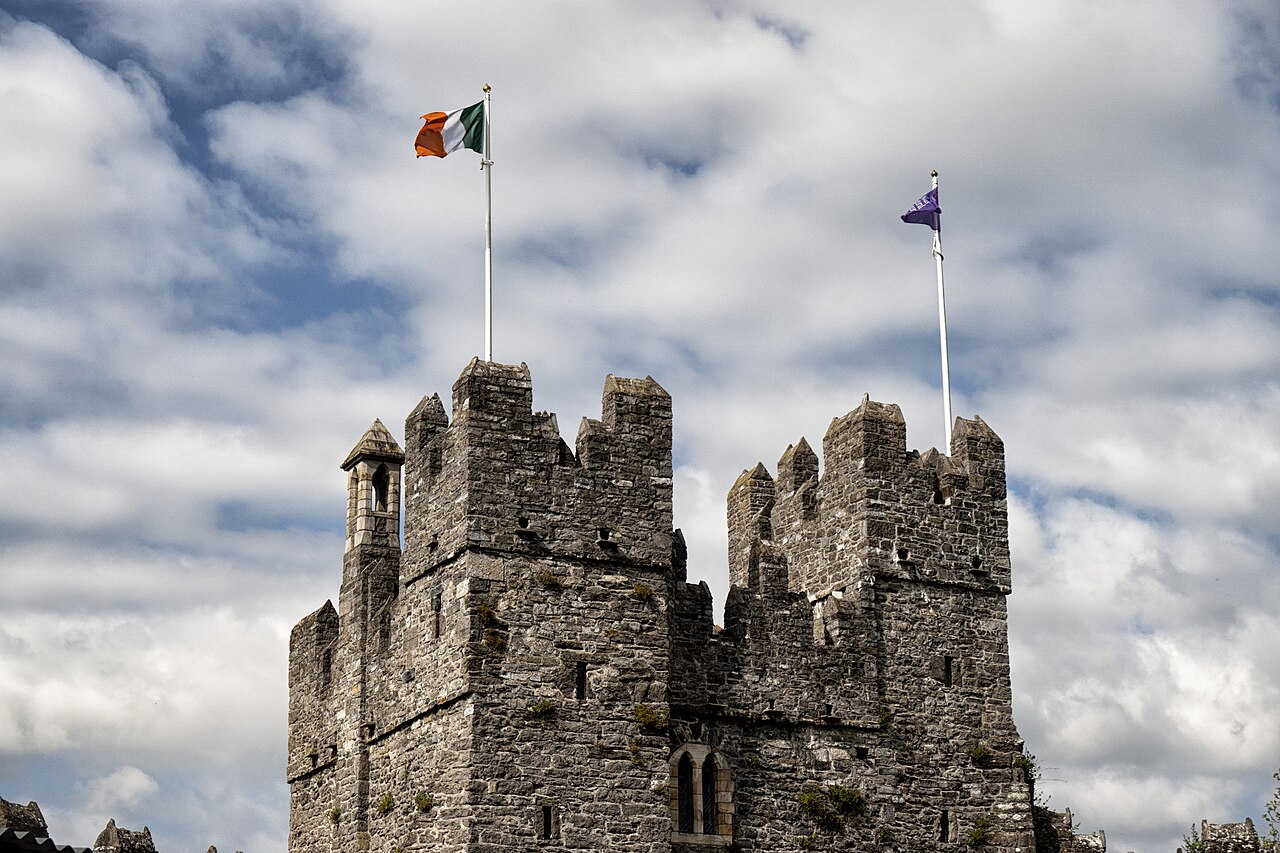
Many lifetimes.
Read the landscape
Old Swords is still here.
You just have to know where to look.
The towers above Church Road, the castle at the head of Main Street and the long plots behind its frontage tell different parts of the same story. This is a chronological guide to those layers. Approximate dates are marked c.; traditions and disputed details are identified in each entry.
Choose a chapter. Open a story.
Swords, through the years
Click a milestone to read more.
Dates are chronological, not to scale.
18 milestones
6th–11th centuries
The early settlement
6th centuryFoundation tradition · AD 560 is conventionalA settlement beside the wellBefore the castle, a religious community took root above the Ward River.Read the story +
Swords traces its early identity to a monastery associated with Colmcille, also known as Columba. The traditional founding date is AD 560. It is best read as a date in the town’s foundation tradition, rather than the equivalent of a surviving foundation certificate.
The well lies at the heart of the story. Local tradition connects the Irish name Sord with clear or pure water and describes the saint blessing the spring. Stories of a miraculous step creating the well belong to folklore. The enduring connection between water, the elevated church site and the town’s name matters even when the details cannot be demonstrated as literal events.
Historical references: Colmcille in Swords · Fingal heritage
Link to this milestone ↗c. 9th–10th centuriesApproximate date · sources differThe round tower risesOne of the town’s oldest surviving landmarks belongs to the monastic landscape.Read the story +
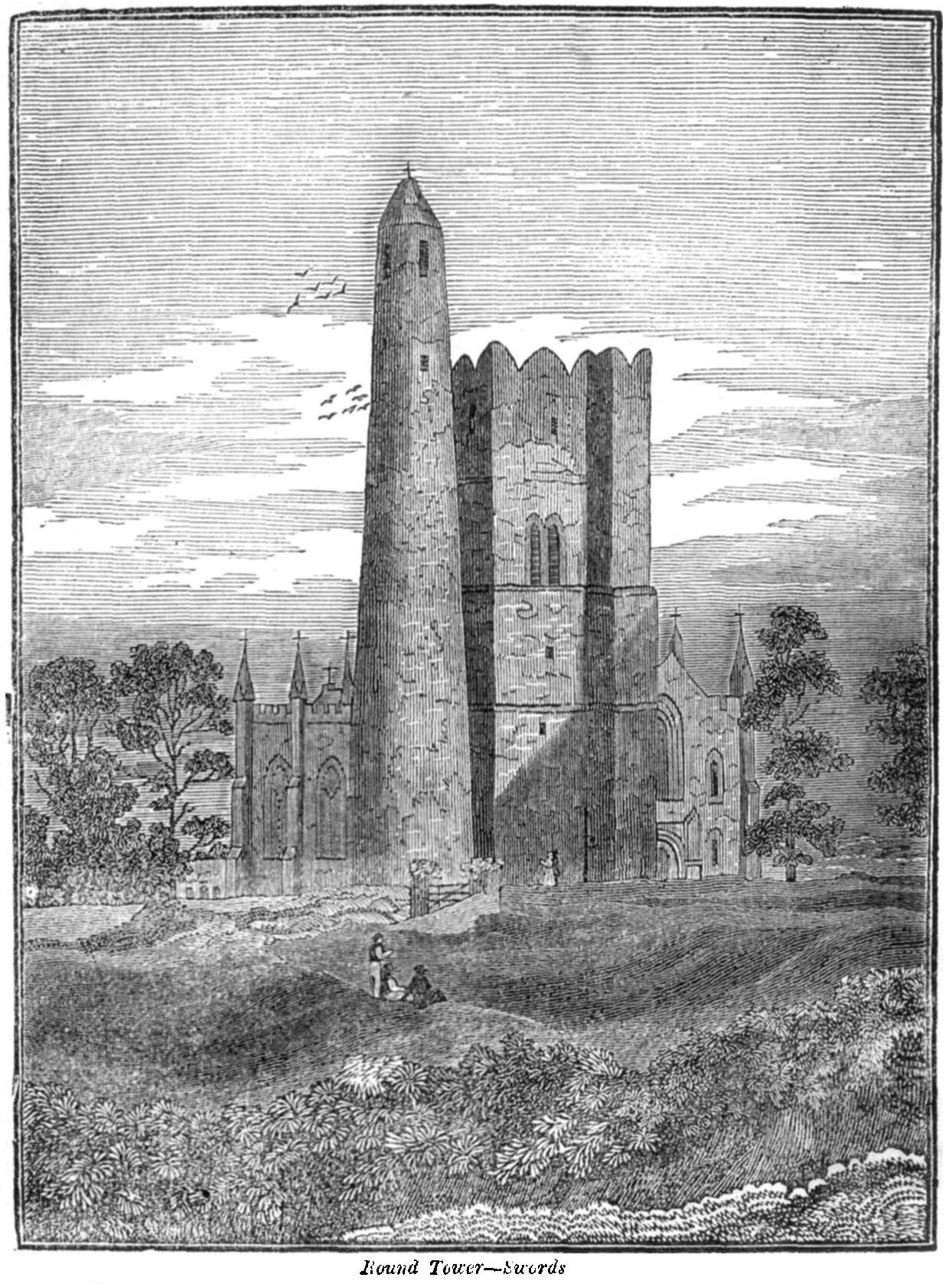
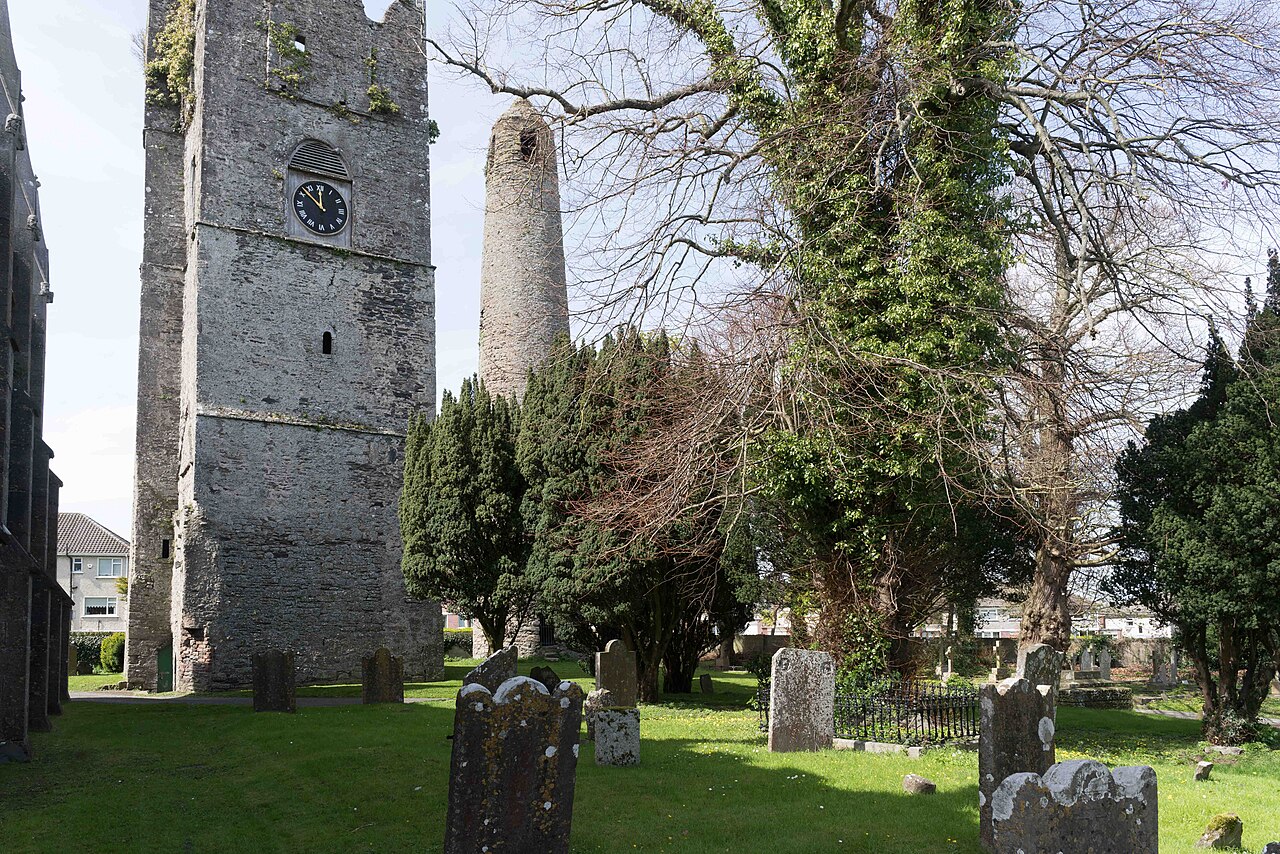
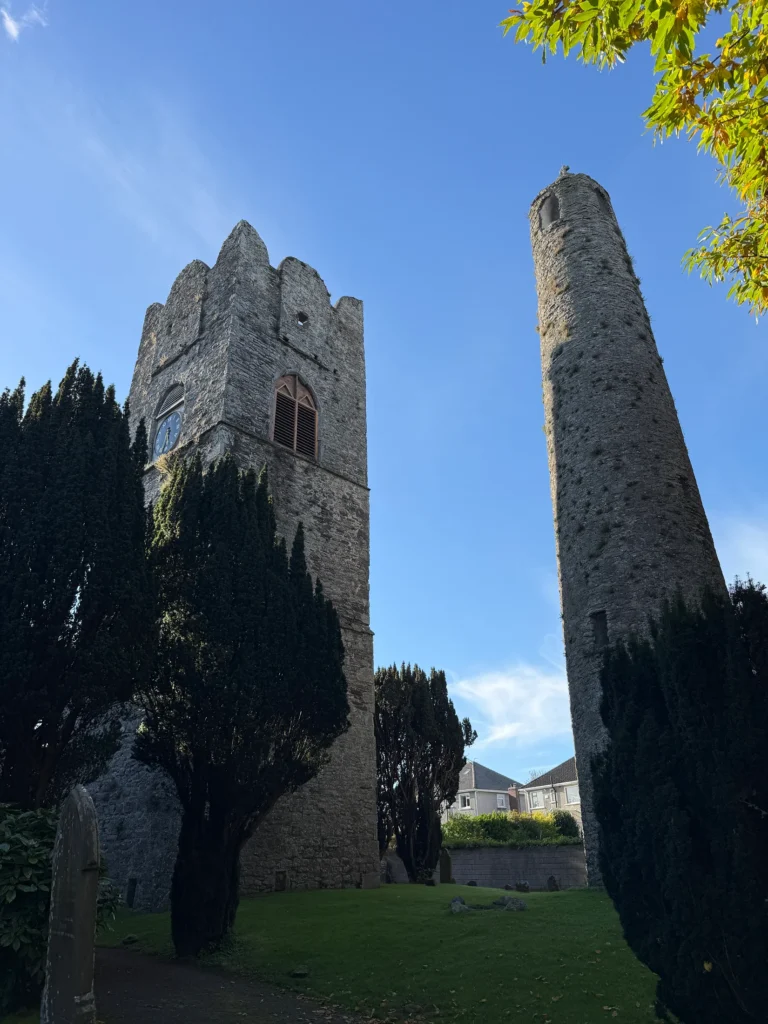
The slender round tower at St Columba’s marks the earlier ecclesiastical centre. Published sources differ over its precise date: Visit Dublin places it in the ninth century, while Fingal’s conservation-area description uses approximately the tenth. A range is more honest than assigning a single building year.
The tower, the separate square medieval belfry and the later church are different generations of building. They should not be described as structures all erected by Colmcille. Looking at them together reveals how the site continued to be adapted long after the early monastery.
Historical references: Swords Round Tower & Belfry · Visit Dublin · Swords Town Health Check · technical appendix · Fingal Development Plan · conservation areas
Link to this milestone ↗1014Recorded tradition · exact resting place uncertainA king’s last journeySwords has a place in the tradition surrounding Brian Boru’s funeral.Read the story +
After the Battle of Clontarf, Brian Boru’s remains are traditionally said to have rested at Swords on their journey to burial at Armagh. The association connects the monastic settlement with a much wider story of kingship and conflict in medieval Ireland.
Tourism accounts sometimes identify the round tower itself as the resting place. We distinguish that more specific tradition from the broader association with Swords: the exact location is not established here. This is a remembered episode in the town’s history, not a claim that a marked royal grave survives in Swords.
Historical references: Swords Round Tower & Belfry · Visit Dublin
Link to this milestone ↗c. 1200–1642
Manor, market & borough
c. 1200Approximate building dateAn archbishop’s manor takes shapeThe castle becomes a second centre of power, across the river from the church site.Read the story +
Swords Castle developed as a residence and administrative centre for the Archbishops of Dublin around the beginning of the thirteenth century. It was an episcopal manor: a place for managing an estate as well as accommodating an important household.
The surviving enclosure is not the product of one building campaign. Walls, domestic spaces and defensive features were altered across generations. Its position at the northern end of Main Street still helps explain the shape of the town: the street approaches the castle while the older religious site stands on higher ground to the west.
Historical references: Swords Castle Conservation Plan
Link to this milestone ↗1326Documentary record · abandonment claim qualifiedA rare inventory opens the doorsA medieval record gives a glimpse of the manor’s working life.Read the story +
The 1326 inquisition records buildings and their condition at the manor, offering an unusually detailed window into a medieval estate. Its descriptions point to a household supported by spaces for storage, food preparation, animals and administration.
The record includes serious disrepair, but it does not prove that Swords Castle was permanently abandoned in 1324. The conservation plan explains that the manor continued in use and that later building activity survives. The familiar story of a castle simply deserted for Tallaght is too neat for the evidence.
Historical references: Swords Castle Conservation Plan
Link to this milestone ↗1578Documented historySwords receives a new borough charterThe town’s trading identity acquires a parliamentary dimension.Read the story +
A new charter under Elizabeth I recognised Swords as a parliamentary borough in 1578. It built on a much older borough associated with the archbishops, rather than creating a settlement from nothing. The 1326 estate record had already counted 122 burgesses.
Burgesses were people with particular rights and obligations within the borough; they were not a count of every resident. Swords sent representatives to the Irish Parliament until the Union brought that parliamentary arrangement to an end. The long street and narrow plots behind its frontage remain clues to the town’s commercial past.
Historical references: Historic Landscape Characterisation of Swords
Link to this milestone ↗1641–1642Historical accounts · precise chronology variesConflict reaches the townThe upheaval of the 1640s draws Swords into fighting around Dublin.Read the story +
Historical accounts describe an armed gathering at Swords in the opening phase of the 1641 rebellion and an attack by forces under Sir Charles Coote. The castle and approaches to the town were part of this contested landscape close to Dublin.
Later summaries do not always align neatly on dates or terminology. We present this as an episode spanning the opening conflict of 1641–1642, without assigning an unsupported exact day, casualty total or dramatic reconstruction. The event is a reminder that the town’s history includes disruption and violence as well as charters and architecture.
Historical references: Swords Town Health Check · technical appendix
Link to this milestone ↗1811–1916
Faith, learning & local lives
1811–1812Documented historyA new St Columba’sA nineteenth-century church joins the much older towers.Read the story +
The present Church of Ireland building belongs to the early nineteenth century. The Irish Architectural Archive’s Dictionary of Irish Architects records Francis Johnston in connection with the church in 1811, and a possible building involvement by Henry, Mullins & McMahon in 1811–1812.
Its Gothic character sits beside the surviving medieval square belfry and early round tower. That contrast makes the site particularly revealing: an ancient place of worship could remain important while its buildings changed. The church seen today is not the original sixth-century monastic church.
Historical references: Dictionary of Irish Architects · St Columba’s · Swords Round Tower & Belfry · Visit Dublin
Link to this milestone ↗1827Documented historySt Colmcille’s Church is builtAnother enduring landmark takes its place off Main Street.Read the story +
The Catholic parish dates its present church to 1827, replacing an older building nearer Main Street. Its account credits Fr James Vincent Carey with securing the site without charge from James Taylor of Swords House, and gives the building cost as £1,820 in the currency of the time.
The church was subsequently altered rather than remaining frozen in its first form. The parish records a two-storey vestry addition in 1879 and later changes to the building. Its history belongs both to the architecture of the town and to the generations who used it for worship, remembrance and family occasions.
Historical references: St Colmcille’s Parish · parish history
Link to this milestone ↗1830sDocumented historyThe town comes into sharper focusDetailed mapping captures the shape of Main Street and its long property plots.Read the story +
Nineteenth-century maps let us follow Swords in much finer detail than earlier road maps. Buildings line Main Street, smaller streets branch away, the Ward River defines the western side of the centre and the castle anchors its northern end.
The long plots behind the street frontage preserve an older pattern of land division. That is why the history of Swords is not confined to its most obvious monuments: the everyday layout of the town also carries evidence. A shopfront may have changed repeatedly while the outline of the property behind it retains a much longer story.
Historical references: Swords Town Health Check · technical appendix
Link to this milestone ↗1908–1909Construction dates differ between recordsA library for the townNorth Street gains a distinctive home for public learning.Read the story +
The Carnegie library’s yellow and red brickwork offers a different kind of landmark from the castle and church towers. The National Inventory of Architectural Heritage describes the building as constructed in 1908, while the local tourist-office history gives 1909. We retain both dates rather than pretending the records agree.
The architectural inventory notes its projecting central bay, moulded stone entrance and original library fittings. Its importance is social as well as architectural: a dedicated library made learning and reading part of the public life of the town. The building later became associated with local history and genealogy.
Historical references: National Inventory of Architectural Heritage · Carnegie Library · Swords Historical Society · local history · Swords Castle · local heritage information
Link to this milestone ↗1916Documented historyLocal lives enter the national storySwords people take part in the Easter Rising, in Fingal and in Dublin city.Read the story +
The Swords Historical Society records local volunteers and families connected with the Easter Rising, including Richard Coleman and members of the Taylor family. Its account describes Swords participants at Ashbourne and others who travelled into Dublin.
This was not a single event contained within the town centre. Following the individual journeys shows how local streets connected with events elsewhere. Coleman survived the Rising but died in Usk Prison in Wales in December 1918. Family histories and archival records provide a more useful route into this period than imagining a battle scene on today’s Main Street.
Historical references: Swords Historical Society · local history
Link to this milestone ↗1940–2014
The making of modern Swords
19 January 1940Documented historyDublin Airport opens nearbyA flight to Liverpool begins a new chapter in the region’s connections.Read the story +
The first commercial departure from Dublin Airport was an Aer Lingus service to Liverpool on 19 January 1940. It was a modest beginning during wartime, very different from the scale of the airport familiar today.
The airport sits outside the historic town core, but its proximity is central to understanding modern Swords. Work, travel and the movement of people increasingly tied the town to an international gateway. Later airport milestones, including Terminal 1 in 1972 and Terminal 2 in 2010, form part of that wider regional story; they are not town-centre construction dates.
Historical references: Dublin Airport · 80th anniversary history
Link to this milestone ↗1960s–1990sDocumented historyFrom a small town to a growing urban centreNew housing and employment transform the scale of Swords.Read the story +
Fingal’s account of the town’s development identifies sustained growth from the 1960s, with a major expansion in the 1970s associated with the Rivervalley estate. Further housing and industrial development followed through the 1980s and 1990s, alongside the expanding airport.
This change helps explain why the historic core can feel compact beside the neighbourhoods that now surround it. Modern Swords is the result of both stories: a much older street and monuments, and the homes, schools, services and daily journeys created by rapid growth. A timeline of the town needs room for ordinary residential life as well as major buildings.
Historical references: Swords Masterplans · Part A
Link to this milestone ↗1 January 1994Documented historyA new council for FingalA change in local government strengthens Swords’ civic role.Read the story +
Fingal County Council came into being on 1 January 1994 as the former Dublin County Council was replaced by three local authorities. This is the modern administrative beginning of the council, not the origin of the much older name or region of Fingal.
The council’s retrospective on its first County Manager, Davy Byrne, records the transition and the subsequent approval for a new County Hall in Swords. These decisions gave the town a larger civic role within north County Dublin, alongside its established residential and commercial functions.
Historical references: Fingal’s first County Manager · retrospective
Link to this milestone ↗2000Documented historyCounty Hall changes the civic landscapeA contemporary building faces the medieval castle.Read the story +
The Sustainable Swords Health Check dates completion of County Hall to 2000 and identifies Bucholz McEvoy with BDP as its designers. It occupies the former Swords House site opposite the castle.
The building’s curved form responds to the site and its mature trees. Placing it beside the castle creates a striking comparison: two very different expressions of administration, built centuries apart. The earlier house has gone, but the location continues to reveal how power and public life have repeatedly gathered around the northern end of Main Street.
Historical references: Sustainable Swords · Health Check
Link to this milestone ↗2001Documented historyPavilions opensA major retail destination adds a new focus beside the old centre.Read the story +
Pavilions dates its beginnings to 2001. Its position between the historic centre and the R132 gave Swords a substantial shopping destination beyond the traditional frontage of Main Street.
The change matters to the town’s story because the centre of everyday activity can move without the old town disappearing. Shopping, leisure and access by car became part of a different pattern of movement. Later plans for Swords would have to consider how these newer destinations and the historic streets could work together, rather than treating either as the whole town.
Historical references: Pavilions Swords · centre history · Swords Masterplans · Part A
Link to this milestone ↗9 September 2014Documented historyA plan for the castle’s futureConservation turns attention to understanding and protecting what survives.Read the story +
The Swords Castle Conservation Plan was published on 9 September 2014. It treats the castle as a nationally important medieval episcopal manor with a long sequence of changes, and sets out a basis for its preservation and presentation.
That date marks publication of a plan, not the completion of every restoration project. It also gives this timeline a useful stopping point: the historic town continues into a present in which buildings are studied, repaired and reused. Current construction programmes and changing delivery dates belong in our separate Projects section, where they can be tracked without turning this history into a news feed.
Historical references: Swords Castle Conservation Plan · publication record
Link to this milestone ↗Three views. One place.
A familiar silhouette,
almost two centuries apart.
Compare the round tower and belfry in an illustration published in 1832, William Murphy’s photograph from 2016 and our own photograph taken on 31 October 2026. Viewpoints and framing differ; these are three views of the landmarks, not a precisely aligned reconstruction.


History, with its workings shown
What we know.
What we treat with care.
The past does not change, but the evidence available to us can. This guide separates local tradition from documentary records, gives date ranges where sources differ and avoids treating later legends as eyewitness accounts.
Research checked 26 October 2026. Current opening hours and construction updates sit outside this historical timeline. For developments happening now, visit Projects ↗.
Have a correction, a family document or a photograph you have permission to share? Contact [email protected]. Please include the origin and date of the material.
Research notes & sources Open the reading list +
- Colmcille in Swords · Fingal heritage
Heritage interpretation; undated page.
- Swords Round Tower & Belfry · Visit Dublin
Visitor heritage record; undated.
- Swords Castle Conservation Plan
Published 2014; history and chronology, pp. 22–30.
- Historic Landscape Characterisation of Swords
Lisa Courtney & Kieron Goucher, 10 May 2007.
- Swords Town Health Check · technical appendix
September 2021; historical development and archaeology.
- Dictionary of Irish Architects · St Columba’s
Irish Architectural Archive; building chronology.
- St Colmcille’s Parish · parish history
Parish historical account; undated.
- National Inventory of Architectural Heritage · Carnegie Library
Record 11335007; recorded 23 July 2000.
- Swords Historical Society · local history
Historical essays and community archive; dated sections include 2016–2018.
- Dublin Airport · 80th anniversary history
Published 19 January 2020.
- Swords Masterplans · Part A
June 2019; development and key features.
- Fingal’s first County Manager · retrospective
Council retrospective; establishment and County Hall dates.
- Sustainable Swords · Health Check
June 2021; County Hall, p. 54.
- Pavilions Swords · centre history
Centre’s own website: operating since 2001.
- Swords Castle Conservation Plan · publication record
Plan published 9 September 2014.
- Fingal Development Plan · conservation areas
2023–2029 plan appendices; Church Road historic core.
- Swords Castle · local heritage information
Undated historical visitor information; Carnegie date 1909.
Texts are original OurSwords summaries. Source links support verification; they do not imply a partnership or endorsement. Image rights are credited beside each image.